Mastering Medical Social Media Post Design with Fully Customizable Templates
A dermatology clinic in Chicago needed to produce a series of educational Instagram posts about skin cancer prevention. The marketing lead, a former nurse with no design background, had two days to create content that was both medically accurate and visually compelling. Rather than hiring an expensive agency or struggling with complex software, she turned to a Medical Social Media Post template designed for rapid customization. Within hours, she had adapted the layout, swapped in clinic-specific colors, adjusted the typography, and scheduled the posts. The campaign later saw a 40% increase in appointment inquiries. This scenario is not rare—it reflects a growing demand for accessible, professional-grade design tools in the healthcare space.
Medical professionals, healthcare marketers, patient educators, and even independent practitioners increasingly rely on visual content to communicate complex information. A well-crafted Medical Social Media Post does more than inform—it builds trust, clarifies health messages, and encourages engagement. But creating such content from scratch is time-consuming and technically demanding. Pre-designed templates that are fully editable, layered, and organized solve this problem. They offer a bridge between clinical accuracy and visual polish, allowing users to focus on message rather than mechanics.
Understanding the Core Specifications of a Medical Social Media Post Template
When selecting or working with a Medical Social Media Post template, the technical specifications determine both quality and flexibility. A 500x500 pixel RGB color design at 300 DPI resolution is the standard for high-definition social media graphics. This square format fits seamlessly across Instagram feeds, Facebook posts, LinkedIn shares, and even Pinterest pins. The 300 DPI ensures that the image remains crisp when printed for brochures, handouts, or posters, while the RGB color space guarantees accurate on-screen color reproduction.
The layered organization of the template is what sets it apart from static images. Each element—background, text boxes, icons, illustrations, and branding assets—sits on its own editable layer. This means a user can hide, reposition, recolor, or delete any component without affecting the rest. For medical applications, this is especially valuable. A doctor might want to replace a generic heart icon with a more specific anatomical illustration. A hospital marketer might need to swap out a standard font for one that aligns with institutional branding guidelines. Layers make these changes possible in seconds.
Compatibility with Adobe Illustrator CS6 and above, along with EPS and JPG file formats, ensures that the template works across different workflows. The AI file offers native editing in Illustrator with full layer access. The EPS file provides a fallback for vector editing in other applications such as CorelDRAW or Affinity Designer. The JPG serves as a ready-to-use preview or quick upload option. This three-format bundle removes technical barriers for users at varying skill levels.
Typography and Color Flexibility in Medical Design
One of the most frequently overlooked aspects of medical social media design is typography. Many templates specify free fonts, which eliminates licensing concerns and keeps production costs low. Free fonts like Roboto, Open Sans, Lato, or Montserrat are not only accessible but also highly legible on small screens, which is critical for health information readability. A Medical Social Media Post template that uses free fonts allows anyone to open the file and start editing immediately without tracking down proprietary typefaces.
Colors in medical design traditionally lean toward blues, whites, greens, and soft neutrals—palettes that evoke calm, cleanliness, and professionalism. But a customizable template in 500x500 pixel RGB format lets the user shift the entire color scheme to match a specific clinic brand, a national health campaign, or even a seasonal awareness event. For example, a cardiology practice might use deep reds and golds during American Heart Month, while a pediatric clinic might prefer bright pastels. Because the template is fully editable, the user can adjust the color of every vector shape, text layer, and background element independently.
Applications Across Healthcare and Medical Communication
The versatility of a customizable Medical Social Media Post extends far beyond simple announcements. Different healthcare contexts demand different visual strategies, and a well-layered template adapts to each.
- Patient Education Posts: A template can be adapted to explain a condition like hypertension or diabetes. The designer places an infographic-style illustration on one layer and adds bullet-point symptoms or prevention tips on text layers. The 300 DPI resolution ensures that even small text remains sharp when zoomed in on mobile devices.
- Clinic Announcements and Promotions: When a dental office introduces a new teeth whitening service, a square social media post with before-and-after imagery, a clear headline, and a call-to-action button works effectively. The layered AI file lets the user swap stock imagery for actual patient photos (with consent) while keeping the branding intact.
- Health Awareness Campaigns: During Breast Cancer Awareness Month, a hospital network might need a series of posts with different statistics, quotes, and donation links. Using a single well-organized template, the team can duplicate the file, change the text and color accents on each copy, and maintain visual consistency across the entire campaign.
- Internal Communications and Training: Medical educators can repurpose a social media template into a training slide or a department poster by taking advantage of the 300 DPI print capability. A layered design allows the removal of social-media-specific elements (like share icons) and the addition of institutional headers.
- Telemedicine Promotions: With the rise of virtual care, many clinics use social media to advertise telehealth options. A template with a clean layout, a phone or laptop vector, and editable text fields for appointment links helps create professional posts in minutes.
Real-World Workflow Example: From Template to Published Post
Consider a physical therapy practice that wants to post a weekly tip series. The owner, a therapist with limited design time, downloads a Medical Social Media Post AI file. Here is how the layered organization streamlines the work:
- Open the AI file in Illustrator CS6 or later. The Layers panel shows named groups such as "background," "icon," "headline," "body text," "cta button," and "branding."
- Customize the background. The user selects the background layer and changes the color from the default blue to a warm gray that matches the clinic's website. Because the layer is separate, nothing else shifts.
- Update the icon. The template includes a generic medical cross icon. The user hides that layer and imports a custom vector of a spine, relevant to physical therapy. The new icon snaps into place.
- Edit the text. Double-clicking the text layers allows the user to type "3 Stretches for Lower Back Pain" in the headline and a short instructional paragraph in the body. The free fonts render immediately without any missing font warnings.
- Adjust the call-to-action. The button layer changes color to a contrasting orange, and the text reads "Book an Appointment."
- Export. The user saves a JPG version for social media and a high-resolution EPS for future print materials. The entire process takes under twenty minutes.
This workflow demonstrates why layered, editable design files are not just a convenience—they are a productivity tool for busy medical professionals who cannot afford to waste time on technical hurdles.
Characteristics That Define an Effective Medical Social Media Post Template
Not all templates serve medical communication equally well. Certain characteristics distinguish a useful Medical Social Media Post from one that requires excessive rework.
Clarity of Hierarchy: Medical information often includes data, statistics, and warnings that must be communicated clearly. A good template uses size, contrast, and spacing to guide the viewer's eye from the headline to the key message to the action step. In a 500x500 pixel square, every pixel counts. Templates that waste space with excessive decorative elements frustrate users who need to convey serious health content.
Medical-Appropriate Visual Language: Icons and illustrations should reflect actual medical concepts—stethoscopes, anatomical shapes, prescription symbols, health graphs—rather than generic abstract shapes. A template that includes contextually relevant vector art reduces the need for the user to source external assets. When the design includes elements like DNA helixes, heart rate lines, or tooth silhouettes, the medical connection is immediate.
Consistency Across a Series: Many healthcare organizations post multiple times per week. A template that is well-organized in layers makes it easy to create a series of posts that share a common background, color palette, and typography while varying the text and icon on each. This builds visual brand recognition over time.
Print-to-Digital Versatility: The 300 DPI resolution means the same Medical Social Media Post file that appears on Instagram can be printed at actual size for a waiting room bulletin board. Users who work in clinics with limited budgets appreciate this dual-use capability. They can design once and deploy in two formats without duplicating effort.
Comparing Editable Templates to Custom Design and DIY Tools
Medical professionals often weigh three options for social media visuals: hiring a graphic designer, using a drag-and-drop tool like Canva, or purchasing editable template files. Each approach has trade-offs, and the layered AI/EPS template occupies a distinct middle ground.
Custom design from a freelancer or agency typically delivers a unique result, but it is expensive and slow. A single social media post can cost hundreds of dollars and require multiple revision rounds. For a clinic that needs twelve posts for a campaign, the cost becomes prohibitive. Moreover, ongoing dependence on an external designer creates bottlenecks. Last-minute posts for urgent health alerts are impossible to produce quickly.
Drag-and-drop online tools are fast and beginner-friendly, but they often limit the user to preset layouts, fonts, and color palettes behind a paywall. Export resolution may be capped at 72 or 96 DPI, making printed materials look pixelated. Additionally, users cannot access the underlying vector layers to make fine adjustments. The result is a post that looks generic and does not stand out in a crowded feed.
A well-structured Medical Social Media Post template in AI and EPS format combines the best of both worlds. The user gets a professional starting point created by a designer, but retains full control over every element. Because the file is vector-based, scaling and resolution are never issues. The free fonts and editable colors allow deep customization without extra cost. And because the template is a one-time purchase, it can be reused indefinitely, making it highly cost-effective for ongoing content needs.
Observations from Real Medical Marketing Teams
Marketing teams at mid-sized hospitals have reported that adopting editable templates reduced their social media production time by roughly sixty percent. Instead of spending hours aligning text boxes or sourcing icons, they now spend that time refining medical accuracy and engagement strategy. One hospital system used a single Medical Social Media Post template family to create over 200 posts for different departments—cardiology, orthopedics, pediatrics, oncology, and urgent care—by simply adjusting colors, icons, and text. The unified visual style helped patients recognize content from the same trusted institution regardless of topic.
Private practitioners, including dentists, chiropractors, and optometrists, often manage their own social media. For them, the simplicity of opening an AI file, editing text, and exporting a JPG is a major advantage. They avoid learning curve frustration and maintain a polished online presence that competes with larger clinics. Several have noted that patients frequently comment on the "professional look" of their posts, which directly correlates with perceived credibility.
Considerations When Choosing a Medical Social Media Post Template
Before purchasing or using a template, users should evaluate several factors to ensure it meets their real needs.
Software Compatibility: The template should explicitly state that it requires Adobe Illustrator CS6 or above. Users on older versions may encounter compatibility issues. Those who do not own Illustrator can use the EPS file in other vector editors, but features like layer naming and text editability may not transfer perfectly. It is wise to confirm workflow compatibility in advance.
Font Licensing: "Free fonts used" is a helpful label, but users should still verify that the fonts are genuinely free for commercial use. Most templates use open-source fonts, but double-checking avoids legal surprises. If the user prefers a different typeface, the editable text layers make swapping fonts trivial.
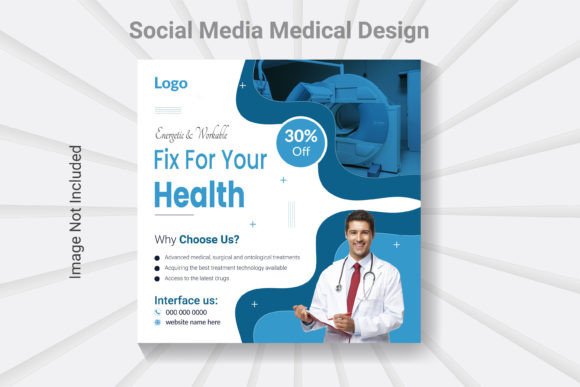
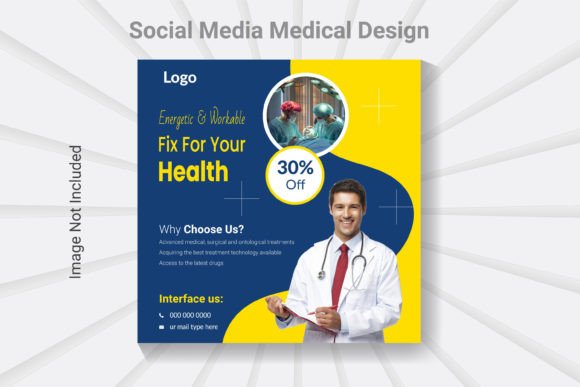
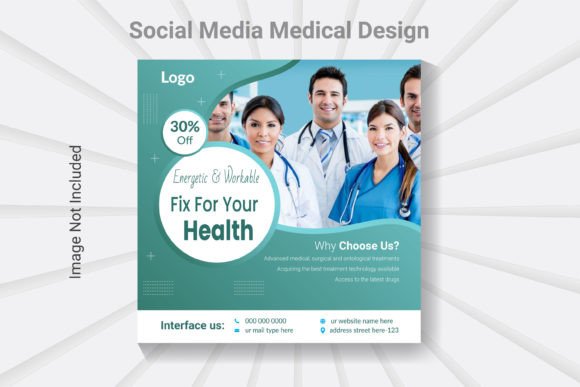
Image Replacement: The template files typically do not include stock photos or patient images. The JPG preview shows a composite with placeholder imagery, but the actual AI and EPS files contain only the vector design elements. Users need to supply their own images or use the included vector illustrations. This is standard practice and keeps the file size manageable while avoiding licensing issues with third-party photographs.
Layer Naming and Organization: A truly well-layered template uses clear, intuitive names for every group and layer—such as "background color," "headline text," "icon left," "footer logo." Disorganized files with names like "Layer 1," "Layer 2," and "Layer 3" defeat the purpose of editability. Users should look for templates that prioritize organized structure in their previews or documentation.
Adapting the Template for Different Social Media Platforms
While the 500x500 pixel size is ideal for square posts on Instagram and Facebook, it can also be adapted for other platforms with minor adjustments. LinkedIn prefers square or slightly rectangular images, and the 500x500 format fits perfectly. For Twitter posts, which use a 16:9 ratio, the user can repurpose the same design by exporting a portion of the composition or by editing the canvas size in Illustrator and repositioning the layers. Because the template is vector-based, scaling or cropping does not degrade quality. This flexibility further extends the value of a single well-made Medical Social Media Post file.
For YouTube thumbnails, the square design can be centered on a 1280x720 canvas with the background layer expanded. The text layers remain sharp because they are vector objects. Healthcare educators who produce both social posts and video content benefit from this multi-format utility.
Future Trends in Medical Social Media Design and Template Use
As healthcare communication continues to shift toward visual and mobile-first formats, the demand for specialized, editable design assets will grow. Artificial intelligence tools now assist with caption writing and hashtag optimization, but the visual core of a post still requires human oversight to ensure medical accuracy and ethical representation. Templates that offer deep customization empower medical professionals to retain that control while keeping pace with content volume.
The 300 DPI standard, once considered excessive for digital use, is becoming more relevant as high-resolution screens and retina displays dominate. Users who future-proof their content by working at 300 DPI ensure that their posts look sharp today and remain usable for print or projection years later. Similarly, the RGB color space aligns with modern screen standards, but users who need CMYK for professional printing can convert the file without losing layer structure.
We are also seeing a rise in collaborative design workflows within healthcare organizations. A centralized template library—stored on a shared drive or cloud service—allows multiple team members to access the same Medical Social Media Post AI file, make departmental edits, and maintain brand consistency across the entire organization. This reduces redundant work and ensures that even junior staff can produce on-brand content.
Templates designed with accessibility in mind—high contrast text, alt-text placeholders, and colorblind-friendly palettes—are becoming more common. As healthcare organizations strive to meet inclusive communication standards, editable templates that allow users to adjust contrast ratios or add descriptive metadata will be preferred.
Ultimately, the value of a customizable Medical Social Media Post lies in its ability to bridge the gap between medical expertise and visual communication. It puts professional design capabilities into the hands of those who understand the content best—clinicians, educators, and patients themselves. When a template is well layered, organized, and built at the right resolution and color specifications, it becomes more than a graphic. It becomes a reusable tool for public health education, clinic growth, and patient trust.
For anyone involved in medical communication, from a solo practitioner in a small town to the marketing department of a large hospital network, investing in a high-quality, editable template is a practical decision. It saves time, reduces costs, and produces consistent, professional results. And in an environment where health information must compete for attention, clarity, and credibility, a well-designed post can make the difference between a scroll and a life-changing appointment.